

Car Lifts 101
Everything You Need to Know
Before You Buy.
Discover the perfect car lift for your garage with our comprehensive buying guide.

TYPES OF CAR LIFTS
Not All Lifts Are Built the Same
Each type serves a different purpose. Here's what they do and who they're for.

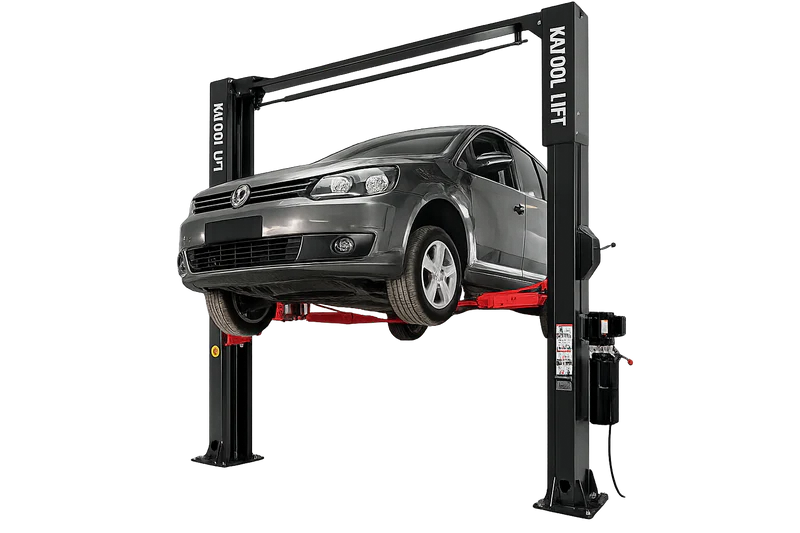
2-Post Lift
Most PopularThis is what you see in just about every professional shop for a reason. Two posts go up, arms swing under the vehicle's frame, and you get wide-open access underneath — nothing in your way. Whether you're swapping brake pads, replacing a strut, or chasing down an exhaust leak, a 2-post gives you the room to actually work. They come in overhead and baseplate setups depending on your ceiling situation.
Best for: Brakes, suspension, exhaust, general service

4-Post Lift
The easiest lift to use, period. You drive on, park it, and hit the button. No messing with arm positioning, no guessing where the lift points are. If you want to stack two cars in a single bay, keep a project car off the ground, or just have a clean setup for oil changes and detailing — this is the one. Add a set of rolling jacks and you can do wheel-off work too.
Best for: Storage, oil changes, detailing

Scissor Lift
Low Ceiling OKGot an 8-foot ceiling? No problem. Scissor lifts sit flat on the floor and rise straight up, so you don't need a tall garage to make them work. They're portable, they don't need to be bolted down, and they plug right into a regular household outlet. Great if you want to do your own tire rotations, brake jobs, or detail work without crawling around on the floor.
Best for: Tire changes, brakes, detailing
2-POST DEEP DIVE
Symmetric vs Asymmetric
The most common question when buying a 2-post lift.
Symmetric
Arms equal length. Car sits centered.

When to choose: Trucks, vans, SUVs, commercial vehicles. More stable for large, heavy rigs.
- Better for heavy vehicles
- Equal weight distribution
- Harder to open car doors (the vehicle sits right between the posts)
Asymmetric
Arms offset. Car shifted back.

When to choose: Sedans, coupes, light trucks, daily drivers. Easier door access so you're not squeezing past a post every time.
- Easy door access
- Best for most cars
- Most versatile option
WILL IT FIT?
Space & Installation Requirements
Check these four things before buying.
Ceiling Height
Your ceiling determines which lifts work.
Concrete Depth
Your slab needs to anchor safely.
Power Supply
Check your electrical panel.
Floor Space
Room plus working space around it.
CAPACITY GUIDE
What Size Lift Do You Actually Need?
Always go 25% above your heaviest vehicle curb weight.
Pro tip
Don't size for what you have — size for the biggest vehicle you might work on. A 10,000 lb lift handles 95% of consumer vehicles.
DELIVERY
How Car Lifts Get Delivered
Lifts ship freight — not UPS. Here's what to expect.
Residential + Liftgate
Delivered to your driveway. Liftgate lowers the crate to the ground. You move it into the garage.
Forklift Required
Too heavy for liftgate. Need a forklift or loading dock at delivery address.
Terminal Pickup
Pick up from the freight terminal yourself. Save on delivery fees.
INSTALLATION
Can You Install It Yourself?
Depends on the lift type. Here's what to expect.
2-Post
ModerateYou're drilling anchor bolts into concrete and standing up some heavy columns. Totally doable yourself, but grab a friend — this is not a solo job. Basic hand tools and a hammer drill will get it done.
4-Post
EasiestBolt the frame together on a level surface. No drilling into the floor. Think of it like assembling heavy-duty furniture — just a lot bigger.
Scissor
Plug & PlayUnbox it, roll it where you want it, plug it in. That's it.
Need help with installation?
We can connect you with local installers. Call us at (888) 885-7067.
SAFETY
What Actually Keeps You Safe
A car lift holds thousands of pounds above your head. Here's what to look for.
Mechanical Locks
These engage automatically as the lift goes up. If the hydraulics ever fail — and that's a big if — the locks are what's actually holding the car. Bottom line: never work under a lift without the locks engaged.
ALI Certification
This means the lift has been independently tested to ANSI/ALI safety standards. It's the gold standard in the industry, though it's not strictly required for home use.
Power Outage?
Car stays right where it is. The mechanical locks carry the weight, not the hydraulics. Most lifts also have a manual lowering valve you can turn by hand to bring it back down.
Regular Inspections
Check cables, chains, and fluid yearly. Look for fraying, leaks, or anything that sounds off. Catching small stuff early keeps big problems from ever happening.
MAINTENANCE
Keeping Your Lift in Shape
Low-maintenance but not zero-maintenance.
Visual inspection
Check cables, leaks, unusual sounds.
Lubricate parts
Grease locks, pulleys, sliding parts.
Hydraulic fluid
Check level, replace if dirty.
Cable inspection
Check for wear, fraying. Replace if damaged.
AVOID THESE
5 Mistakes People Make
We see these all the time. Don't be that guy.
Buying too small
You grab a 7,000 lb lift for your Camry and then six months later you're looking at trucks. Always size for the biggest vehicle you'll ever work on — not just the one in your driveway today.
Not measuring the ceiling
Overhead 2-post lifts need 11-12 ft of clearance. Most residential garages sit around 8-9 ft. Measure before you order — not after the crate shows up.
Ignoring the concrete
A 2-post lift needs 4-6 inches of reinforced concrete to anchor into. If your slab is cracked, thin, or has no rebar, it's not going to hold safely. Get it checked first.
Wrong electrical setup
Most lifts run on 220V/30A — same kind of outlet your dryer uses. If your garage only has standard 110V, you'll need an electrician before the lift goes in. Scissor lifts are the exception — they run on regular household power.
No plan for delivery
These crates weigh over 1,000 lbs. The freight truck drops it at the curb. If you don't have liftgate delivery or a forklift lined up, you're going to be staring at a crate you can't move. Have a pallet jack ready — or some very motivated friends.